Biosimilar Entry and the Pricing of Biologic Drugs
Review of Industrial Organization, 2026
Author’s version(PDF) · Journal version
Policy citations: HHS ASPE brief (2025)
Biosimilars vs. Generics
An important feature of prescription drug markets is the entry of generic versions of branded drugs. The Hatch-Waxman Act of 1984 helped facilitate the entry of generics. Generic penetration typically reaches 90% or more for most drugs after the branded version loses exclusivity.
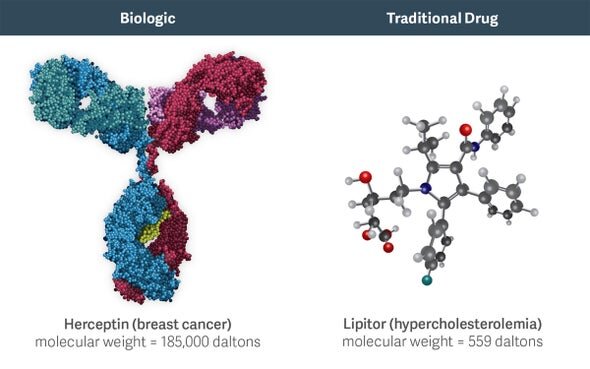
Recently, complicated drugs known as biologics, grown from organic tissue, have become more prominent in approvals and as a share of overall drug spending. Due to their complexity, biologics cannot be exactly replicated, and are therefore immune from generic competition. The US passed the Biologics Price Competition and Innovation Act (BPCIA) in 2009, in order to facilitate the entry of biosimilars, (inexact) copies of biologic drugs. Because biosimilars are not identical copies, many have wondered if biosimilars can be effective competitors, and how reference biologics will react to biosimilar entry.
How Do Biologics and Biosimilars Compete?
How should an originator respond to the entry of imperfect copies of its product? We build on a classic framework from the study of generic entry (Frank and Salkever, 1992): some patients and physicians are “loyal” to the original drug and unlikely to switch, while the rest will go wherever the price is best. The originator therefore chooses between two strategies—“fight,” cutting prices to defend the price-sensitive segment, or “acquiesce,” conceding that segment and serving its loyal customers at high prices. Fighting is more attractive when entrants are few, when they are perceived as lower quality, and when the loyal segment is small—precisely the conditions biologics face when biosimilars enter.
What Happens After Biosimilars Enter?
We combine data on list prices (measured by Wholesale Acquisition Cost, or WAC), net prices (measured using average net revenue per unit and Average Sales Price, or ASP), units sold, and formulary coverage of biologic drugs and examine how these quantities react to biosimilar entry. We find that originator biologics react to biosimilar entry by keeping list price constant but offering larger rebates. Perhaps because of the larger rebates, we also find that biologics only suffer a slight decrease in units sold and formulary coverage after biosimilar entry.
We also compare biologics facing biosimilars with small-molecule brands facing generic entry. Small-molecule brands do not compete on price: after generic entry, their net prices decline only slightly while their volume collapses, and their formulary coverage falls about twice as much as that of biologics facing biosimilars. The contrast matches the model: generic entrants are more numerous and are perceived as close substitutes, so small-molecule originators retreat to their loyal segment, while biologics cut net prices to defend their volume.
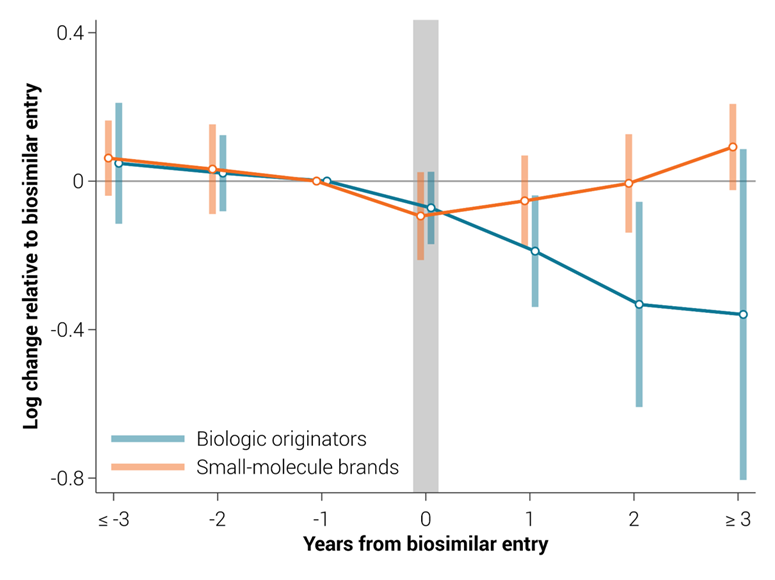
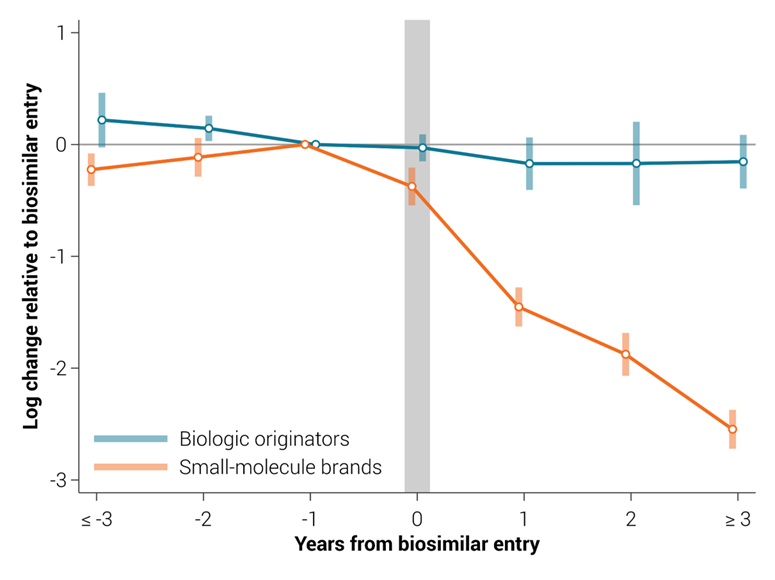
Cuts of the data by proxies for entrant quality and for the size of the originator’s loyal segment also line up with the model’s predictions, though with few biosimilars approved to date the paper treats these tests as suggestive.
Key Takeaways
- Entry of biosimilars does appear to generate some savings. These savings cannot be detected using only invoice sales data, which may help explain why some previous studies (see, e.g., here) have argued that biosimilars are ineffective.
- The way competition between biosimilars and reference biologics unfolds is a crucial determinant of the success of biosimilars (in terms of their ability to reduce prices and displace incumbents).
- Recent bipartisan proposals in Congress have aimed either to raise physicians’ and patients’ confidence in biosimilars or to strengthen the financial incentives for prescribing them. Our model suggests that these approaches could shift the equilibrium regime from a “fight” to an “acquiesce” state.
- This shift could also happen more organically as more patients and physicians become comfortable with biosimilars (a 2020 poll by HarrisX found that only 35% of Americans are familiar with the term “biosimilar”).